Dartboard Maintenance: How to Make Your Dartboard Last Longer
Introduction
A quality dartboard can provide years of play—but even a premium board will wear quickly if the same areas are hit repeatedly and the board is never rotated.
Most wear appears around the treble 20, followed by other popular scoring areas and the bullseye. This can make it seem as though the board itself is poor quality when the real problem is often uneven use.
Fortunately, looking after a modern bristle dartboard is simple. Regular rotation, suitable dart points and a dry environment can make a significant difference to how long it lasts.
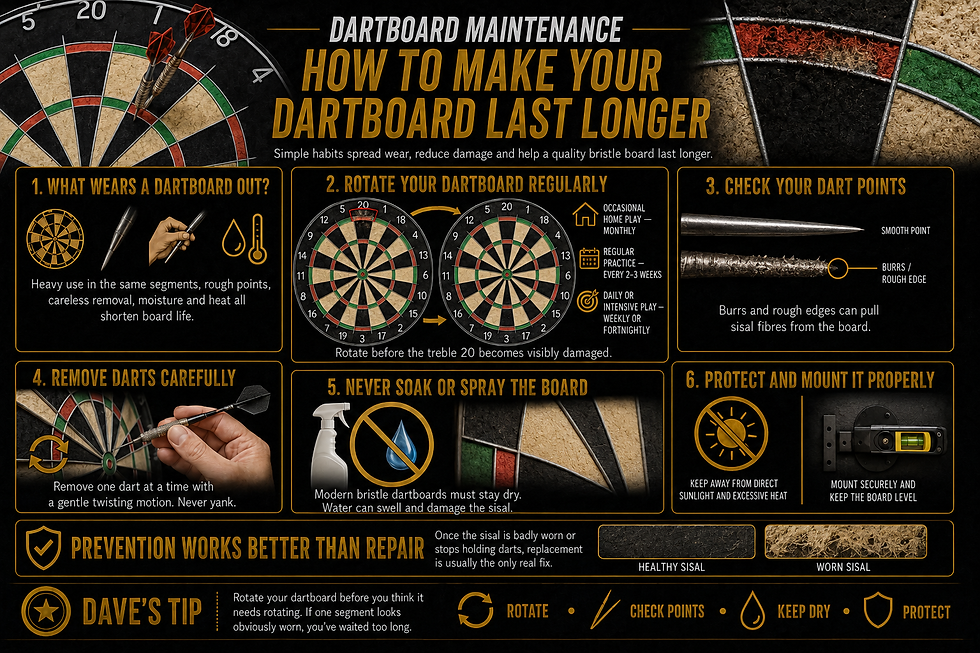
What Causes a Dartboard to Wear Out?
Every dart compresses and separates a small number of sisal fibres when it enters the board.
Quality sisal is designed to recover after the dart is removed, but no area can recover indefinitely if it receives far more use than the rest of the board.
Common causes of premature wear include:
Never rotating the board
Damaged or hooked dart points
Pulling darts out sideways
Moisture and excessive humidity
Direct sunlight or strong heat
Loose or unstable mounting
Concentrating almost every practice session on the same target
The aim of dartboard maintenance is not to prevent normal wear. It is to spread that wear more evenly across the entire playing surface.
Rotate Your Dartboard Regularly
Rotation is the single most important thing you can do to extend the life of a traditional bristle dartboard.
To rotate your board:
Remove or loosen the number ring.
Turn the board so a less-used segment moves into the number 20 position.
Refit the number ring with 20 centred at the top.
Check that the board remains level and securely mounted.
This moves the most heavily used scoring areas onto fresher sisal while allowing previously targeted sections to recover.
How often you should rotate depends on how much you play:
Occasional home play: approximately once a month
Regular weekly practice: every two to three weeks
Daily or intensive practice: weekly or fortnightly
These are guides rather than strict rules. If one section is beginning to look noticeably different from the others, rotate the board sooner.
Don’t Wait Until the Treble 20 Is Destroyed
Many players rotate their board only after the treble 20 has already become pale, compacted or badly worn.
By that stage, rotation can redistribute future use, but it cannot completely restore damaged or missing sisal.
It is better to rotate before the wear becomes obvious. Treat rotation as routine maintenance rather than a repair.
A simple recurring reminder on your phone can prevent months from passing between rotations.
Check Your Dart Points
The condition of your dart points affects both grip and board wear.
Points should enter the board securely without tearing excessively at the sisal. Deep grooves, hooks, burrs or damaged tips can catch the fibres as the dart is removed.
Check your points occasionally for:
Burrs or sharp raised edges
Deep grooves
Hooked or bent tips
Rust or surface damage
Excessive bluntness causing bounce-outs
A lightly textured point may provide useful grip, but a badly damaged point can pull fibres from the board every time the dart is removed.
If you are uncertain whether you need traditional steel-tip or electronic soft-tip equipment, see our guide to Steel Tip vs Soft Tip Darts.
Remove Darts Carefully
How you remove your darts matters.
Grip the darts firmly and pull them straight out of the board. A slight controlled twist may help, but avoid pulling sharply sideways or using the barrel and shaft as a lever.
Sideways force places unnecessary pressure on the sisal and can worsen existing damage around tightly grouped darts.
Taking one extra second to remove your darts carefully is worthwhile, particularly if you use aggressive or heavily textured points.
Never Soak or Spray a Modern Dartboard
Older advice sometimes suggests applying water to a dartboard to prevent it from drying out.
Do not do this with a modern bristle dartboard.
Water, cleaning sprays, steam and excessive moisture can cause the sisal to swell, distort or soften unevenly. Moisture may also affect the board’s adhesives, wiring and printed surface.
To keep the board clean:
Keep it indoors
Use clean darts
Remove loose surface dust gently
Avoid household cleaners
Never scrub or wet the sisal
A dartboard should be kept dry and allowed to look after itself.
Protect the Board From Heat and Sunlight
Sisal is a natural material, so its environment matters.
Avoid placing your board where it receives:
Direct sunlight
Heat from a nearby heater
Damp or humid conditions
Outdoor weather exposure
Large and repeated temperature changes
Direct sunlight can fade the colours and dry the playing surface unevenly. Moisture can create the opposite problem by causing swelling or distortion.
A stable indoor location is best.
Keep the Board Secure and Level
A dartboard that moves whenever a dart lands is frustrating to use and may gradually loosen its mounting hardware.
Check occasionally that:
The wall bracket remains secure
The board sits firmly against the wall
Levelling feet or stabilisers remain correctly adjusted
The number 20 is centred at the top
The board has not shifted from its official position
If you are setting up a new board, follow the official dartboard height and throwing-distance measurements.
Good dartboard lighting also makes the playing surface easier to see without relying on harsh or uneven room lighting.
Can a Worn Dartboard Be Repaired?
Minor wear can often be managed by rotating the affected area away from the highest-use positions.
However, a badly worn dartboard cannot be returned to new condition. Water, glue and other home-repair methods are more likely to create additional problems.
Replacement may be necessary when:
Large areas of sisal no longer recover
Sections become badly compacted or begin breaking apart
The playing surface bulges or separates
Wires become loose or badly distorted
Bounce-outs become excessive after checking the dart points
The board no longer holds darts reliably
Before replacing a board, make sure the problem is genuinely the board rather than damaged points, incorrect mounting or one heavily worn segment.
Dave’s Tip
Rotate your dartboard before you think it needs rotating.
The difference between a board that wears out quickly and one that lasts for years is often not its original price. It is how evenly it has been used.
A premium board left permanently in one position can develop a badly worn treble 20 surprisingly quickly. A more affordable board that is rotated consistently may provide excellent service for much longer.
Regular maintenance will usually deliver more value than simply buying a more expensive board and forgetting about it.
Final Thoughts
Dartboard maintenance does not require special cleaners, complicated tools or much time.
The most important habits are:
Rotate the board regularly
Check your dart points for damage
Remove darts carefully
Keep the board dry
Protect it from heat and direct sunlight
Check that it remains secure and level
If you are buying your first board or replacing a worn one, our dartboard buying guide explains the differences between common options and helps you choose a board suited to your setup.
Helpful Guides
Shop Dartboards and Accessories
Browse our darts and dartboard range online, or contact us for help choosing a board and home setup.